
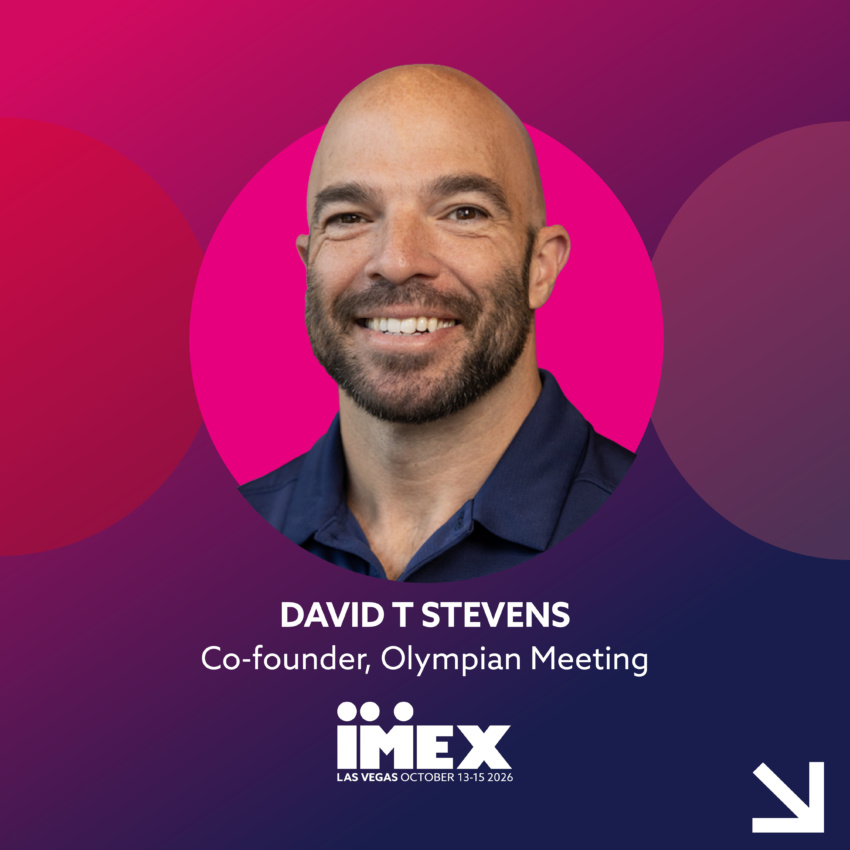
With attendee well-being increasingly shaping event experiences, the IMEX team caught up with David T. Stevens to find out what he’s bringing to IMEX America this year and why wellness is becoming a business imperative for event organizers.
David T. Stevens, Co-Founder, Olympian Meeting
“Who wants to leave an event feeling exhausted, like they need a vacation? Thought so. The question is no longer whether wellness belongs at events. The real question is whether we're designing events to support the people attending them.
Participant expectations have fundamentally changed.
Today's attendees don't have to guess how an event is affecting their well-being. They arrive on site with wearable devices tracking their sleep quality, activity levels and stress markers. Every day they receive a real-time report card on how travel, networking events and late-night receptions are all adding up—and impacting their health and performance.
Increasingly, attendees are assessing an event based on criteria including how it made them feel, not simply what they remember about it.
And that shift raises an important question for our industry: if we're asking people to travel across time zones, sleep in unfamiliar environments, spend hours networking and making critical business decisions, why aren't we designing events that actively support their performance?
Wellness has entered a new era
We're witnessing a broader transformation in the global wellness economy. The Global Wellness Institute estimates the wellness economy at approximately $7 trillion, with wellness tourism approaching $900 billion. What's particularly fascinating is that most wellness spending isn't happening on dedicated wellness retreats. The vast majority comes from travelers—including business travelers—who are incorporating wellness activities into trips they’re already taking.
Proof, if we needed it, that people aren't turning off their health goals when they attend conferences. Many work hard at home to establish routines around movement, sleep, nutrition and mental performance—and they're looking for ways to maintain them.
Introducing Circadian Cove Rx
At IMEX America this October, we're premiering Circadian Cove Rx, the next evolution of our Circadian Cove platform.
Circadian Cove was originally developed in partnership with Dr. Jess Garza of Legacy Mindset as an evidence-based wellness environment built around circadian rhythm alignment (that’s your body’s natural internal clock), human performance psychology, recovery and energy management.
From the beginning, our goal was to create an environment that actively helped people recalibrate, recover and perform better.
Now we're taking that concept even further. Through a new partnership with Carbon World Health and its co-founder, Dr. Nestor Rodriguez, a board-certified Emergency Medicine physician, we’re able to introduce a medical-grade wellness component to the experience (RX is a commonly-used term for “prescription” here in the US). This isn't about elevating wellness through big claims or trendy activations. It's about introducing real rigor and credibility into how wellness is delivered—and all free of charge for attendees.
The objective is simple: to help attendees maintain their wellness practices while away from home.
Here’s what attendees can expect:
- Acute support: Recovery-focused treatments such as red-light therapy, cryotherapy and guided breathwork—all designed to support readiness and recovery
- Maintenance support: Providing access to movement, hydration, metabolic and physiological support services that participants may struggle to access while traveling
- Educational support: Not everyone needs or wants a full treatment, but every participant can benefit from better understanding how their body performs under event conditions. We’ll have educational programming around recovery, light exposure, nervous system regulation, hydration, metabolic health and sleep support. Sessions include: Glow strong: 3 secrets to skin-powered immune resilience; The art of getting over yourself: belonging hacks for the modern world; Brain break: stress & focus reset.
The opportunity ahead
Event design has evolved from simply filling agendas to creating environments where people can connect more meaningfully and show up at their best.
Here’s an example: before MPI's WEC in June, we partnered with La Cantera Resort in San Antonio on what was essentially a wellness-focused fam trip. When guests arrived, we welcomed them with a "Creatini" instead of a traditional cocktail. It was a functional, calorie-conscious mocktail infused with creatine. During the site visit, we paused for two minutes of guided breathwork by the pool. Nothing complicated—just an opportunity to slow down and be present. And at dinner, rather than encouraging another late night, we served freshly brewed sleep-supporting tea that attendees could take back to their rooms, particularly helpful for anyone dealing with jet lag.
None of those moments were expensive. None required a major overhaul of the program. That's where I believe the industry is heading.
People are investing more in their health than ever before and they're bringing those expectations with them when they travel. They're looking for experiences that support their energy and overall well-being, not experiences that leave them needing a vacation after the event ends.
The event professionals who recognize this shift early will have a significant advantage—the future belongs to experiences which leave people energized, not exhausted.”